

Health & Wellness
by Himanshu Garg
12 Views
The most wasteful thing in a lot of Indian bathrooms isn't what you'd guess

I want to talk about something that doesn't come up much in sustainability conversations, probably because it's a little awkward. Sanitary pads.
A study by Toxics Link, an environmental research organization, found that India's landfills receive around 12.3 billion sanitary napkins every year. That works out to roughly 113,000 tonnes of waste annually, just from pads. A single conventional pad is close to 90 percent plastic once you count the top sheet, the absorbent core, and the leak-proof backing. And a pad like that takes somewhere between 250 and 800 years to break down. Not compost in a season. Centuries.
I did the math on that a few times because it didn't feel real the first time I read it. Someone using disposable pads through their reproductive years will send several thousand pads to a landfill or, more often in India, to open dumping or incineration, over their lifetime. Every one of those will still be sitting there, mostly intact, long after everyone reading this is gone.
Why this doesn't get talked about enough
Part of it is that periods are still treated as a private, slightly embarrassing subject in a lot of Indian households, which means the waste question never really gets raised the way plastic bags or bottles do. Part of it is that the alternatives, cloth pads and menstrual cups, come loaded with old assumptions about hygiene and convenience that mostly aren't true anymore, but are hard to shake.
Here's the part of the Toxics Link findings that stuck with me the most. Eighty-eight percent of the people they surveyed said they'd be interested in switching to a more eco-friendly option. The main reason they hadn't was availability. Not preference, not squeamishness. They wanted the alternative and couldn't easily get it.
That statistic is basically the reason a company like ours exists. Because the plastic pad's biggest advantage was never that it's better. It's that it's everywhere, in every kirana store and every supermarket, at a price point that doesn't require planning ahead. If you want someone to switch to something better for the planet and, frankly, often better for their body, it has to be sitting in the same easy reach.
A separate report from the Centre for Science and Environment adds a detail I didn't expect. Fewer than half of Indian women currently use disposable pads at all. Among women aged 15 to 24 specifically, it's under 42 percent. Cloth and other non-disposable options are already the norm for a huge number of households, often because that's what's affordable and available where they live, not because of some deliberate eco-conscious choice. That tells me the market for a well-made, affordable reusable pad isn't a niche we'd be creating from scratch. It's already there, just underserved by decent products.
What actually changes with reusable pads
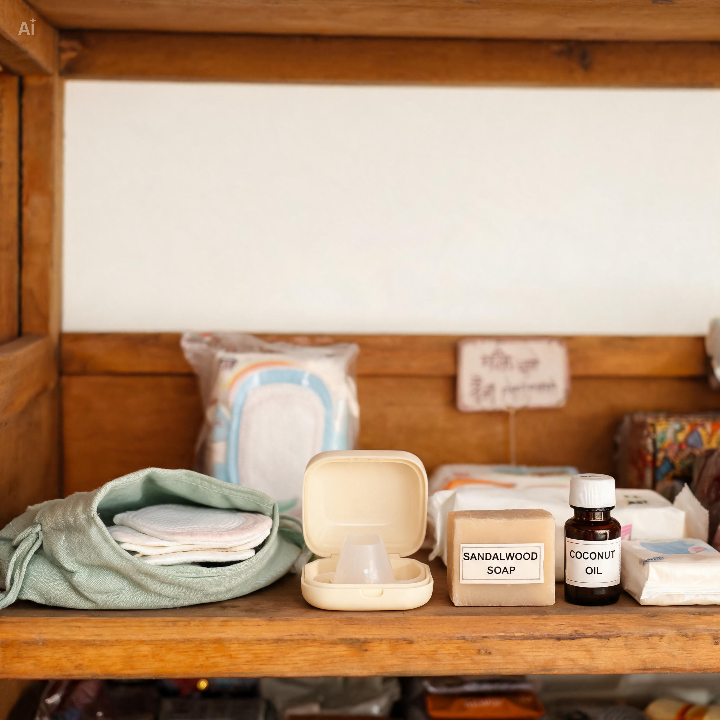
A good cloth pad, used and washed properly, lasts a few years. Over that time it replaces hundreds of disposable pads that would otherwise be sitting in a landfill for centuries. The upfront cost is higher than a single packet of disposable pads, which I won't pretend isn't a real barrier for a lot of households working on tight monthly budgets. But spread that cost across the years the pad actually lasts, and it comes out cheaper than buying disposables every single month, sometimes by a wide margin.
Menstrual cups solve a similar problem in a different form, and Toxics Link's review specifically flagged cups as the main non-plastic option currently available at scale in India. They're not for everyone, comfort and access to clean water vary a lot by household, but for people who do get on with them, a single cup can last years and generates essentially no ongoing waste at all.
None of this is a small thing to change for someone who's used disposable pads her whole life. Habits around periods are personal and often tied to what felt safest and most manageable during years that weren't always easy to navigate. I'm not interested in guilting anyone about a pad they bought last week. I am interested in making sure that when someone is ready to try something different, it's sitting on a shelf they actually shop at, priced in a way that doesn't feel like a luxury decision. Eighty-eight percent of people already want this. The job left is making it ordinary.
Sources and further reading
Down To Earth, "India's landfills add 113k tonnes of menstrual waste each year: Report" (citing Toxics Link study): https://www.downtoearth.org.in/waste/india-s-landfills-add-113k-tonnes-of-menstrual-waste-each-year-report-77247
WION, "India annually generates over 3 lakh tonnes of waste from sanitary napkins and baby diapers: Report" (citing CSE's "Sanitary Waste Management in India" report): https://www.wionews.com/india/india-annually-generates-over-3-lakh-tonnes-of-waste-from-sanitary-napkins-and-baby-diapers-report-484389