

Environment news
by Himanshu Garg
10 Views
The plastic ban is four years old. Here's what's actually different.

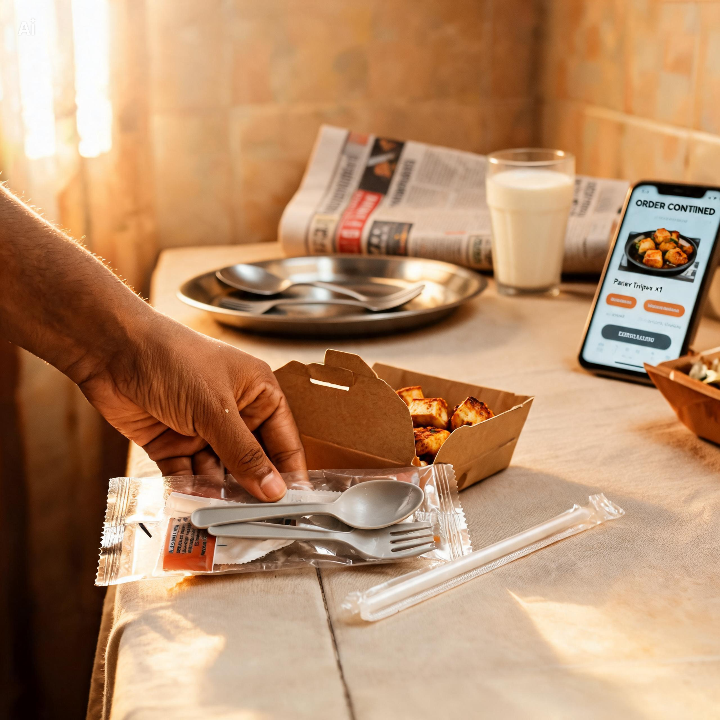
India banned nineteen single-use plastic items in July 2022. Straws, cutlery, ear buds, thermocol decorations, plastic flags, the small stuff that's easy to replace and easy to forget you're even using. I remember thinking at the time that this would visibly change things within a year or two. It's now been over four years, and I still get plastic cutlery with home delivery more often than not.
That's not me being cynical for the sake of it. The Centre for Science and Environment ran a review of the ban's implementation and their conclusion, in plain language, was that banned items are still being sold and used across the country. A former Supreme Court judge sat on the panel discussing why. It wasn't a fringe complaint.
What the enforcement numbers actually show
To be fair to the government, enforcement hasn't been nothing. Since the ban took effect, authorities have carried out over 8.6 lakh inspections, seized close to 2,000 tonnes of banned plastic items, and collected close to 20 crore rupees in fines. That's real activity. But set it against the scale of the problem and it starts to look thin. India generated about 41 lakh tonnes of plastic waste in 2022-23 alone, roughly the same as the year before that. Nearly 2,000 tonnes seized against 41 lakh tonnes generated is a rounding error.
This April, the government issued an amendment to the plastic waste rules that I think is actually more consequential than the 2022 ban, even though it got far less attention. It requires companies making rigid plastic packaging to steadily increase the share of recycled plastic they use, climbing from 30 percent up to 60 percent by 2028-29. Companies that miss a year's target can carry the shortfall forward for up to three years, and there's a new system letting companies buy recycling credits from others who've overperformed. It's less dramatic than a ban. It's also aimed at the part of the plastic problem that a ban on straws was never going to touch, which is packaging, the biggest single source of plastic in most households.
Where this leaves an ordinary household
I bring all this up because I think there's a version of "sustainable living" content that treats the whole issue as a matter of personal discipline. Carry your own bag, refuse the straw, and if you do those things you've basically solved it. The numbers above tell a different story. A household refusing single-use plastic is working against a system where the products themselves are still being manufactured and sold at scale, where enforcement covers a sliver of what's generated, and where the actual packaging overhaul is only just starting and won't be complete for years.
I don't say this to make anyone feel like individual choices are pointless. I say it because I think we owe each other honesty about what those choices are and aren't doing. Carrying a cloth bag to the market doesn't fix a supply chain. What it does is stop contributing your own household's share of the problem, and it keeps you in the habit for whenever the bigger structural stuff, like the 2026 recycled content rules, actually starts to bite.
The households I want to reach with what we make are not the ones agonizing over whether to accept a plastic straw at a restaurant. They're the ones who'd switch to a steel container over a plastic one without thinking twice, if the steel one cost roughly the same and was sitting on the same shelf. That's a much smaller ask than eliminating plastic from your life through willpower alone. It's just making the ordinary choice slightly easier and slightly cheaper than it currently is. Four years into a ban that's still only partially working, I think that's the more honest place to put our energy.
Sources and further reading
Centre for Science and Environment, "Ban on Single-Use Plastics in India": https://www.cseindia.org/ban-on-single-use-plastics-in-india-11834
Press Information Bureau, "Plastic Waste Management" (Parliament question, enforcement and generation data): https://www.pib.gov.in/PressReleasePage.aspx?PRID=2244106®=3&lang=1
PMF IAS, "Plastic Waste Management (Amendment) Rules, 2026": https://www.pmfias.com/plastic-waste-management-amendment-rules-2026/