

Environment news
by Himanshu Garg
9 Views
Delhi's air is the "cleanest in 8 years." I don't think that word means what we want it to mean.

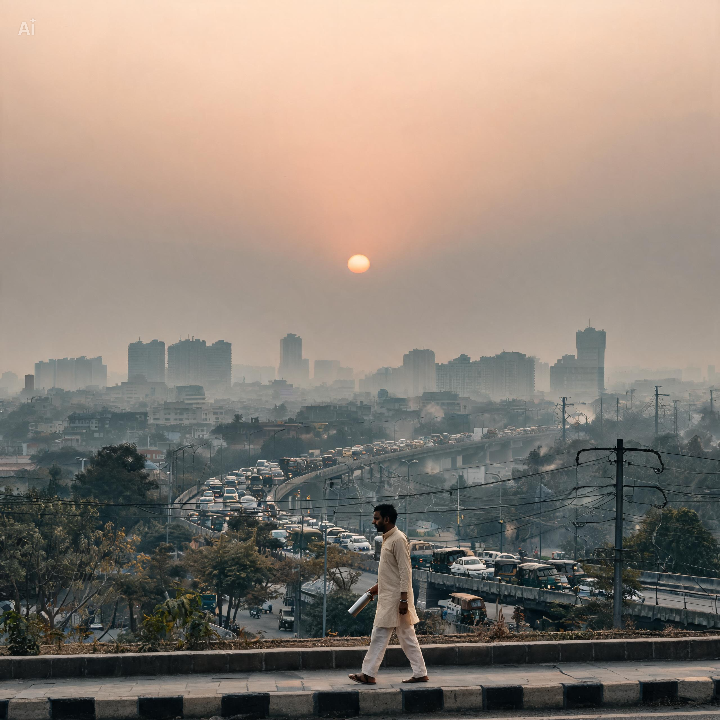
I read a report last month that made me stop and reread it twice. The Commission for Air Quality Management put out data showing Delhi had its cleanest January to May in eight years. My first reaction was relief. My second reaction, once I actually looked at the number, was something closer to unease.
The average AQI for that period was 211. That is genuinely the best Delhi has managed since 2018, if you set aside 2020, when the whole country was locked indoors and traffic and construction basically stopped. Compared to 2022's 238 or 2018's 243, 211 is real progress. I don't want to take that away from anyone working on it.
But 211 is still in the "poor" category. On a scale where anything under 50 is considered good, we are celebrating a number more than four times that, because it used to be worse. That is the part I keep sitting with. We have gotten so used to bad air that a slightly less bad number feels like a win.
The bigger picture is worse
Around the same time, the Centre for Research on Energy and Clean Air published its own analysis, looking at January 2026 data across the country. Out of 248 cities with usable monitoring data, 123 breached India's own PM2.5 standard of 60 micrograms per cubic metre. Not one city, out of all of them, met the World Health Organization's daily guideline of 15 micrograms per cubic metre. Not one.
Ghaziabad topped the list at 184. Delhi came second at 169. Noida, Gurgaon and Greater Noida weren't far behind. Zoom out to the state level and it gets more uneven still: in Rajasthan, 23 out of 34 monitored cities exceeded the standard. In Haryana, it was 19 out of 25. The cleanest city in the whole dataset was Damoh in Madhya Pradesh, at 17 micrograms per cubic metre, which is still above the WHO guideline.
A CREA analyst quoted in the coverage made a point I think is worth repeating: pollution doesn't respect city borders. You can't fix Delhi's air by only fixing Delhi. Emissions from Ghaziabad, Noida and Gurgaon sit in the same airshed. Punjab's stubble burning ends up in Delhi's lungs. Everyone downwind pays for everyone upwind's choices.
Why I keep coming back to this
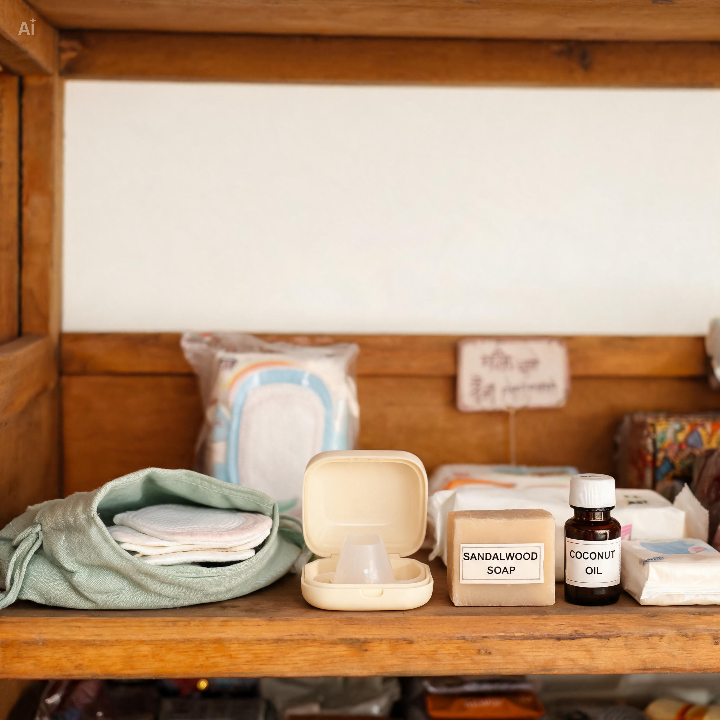
I'm not a scientist and I don't run a policy think tank. I run a small company that sells things like reusable cotton pads and steel dabbas. So why does an air quality report matter to what we do here.
Because I think there's a lazy assumption that environmental damage in India is mostly about air you can see and rivers you can smell, and that the fix is somebody else's job, usually the government's. And a lot of it is the government's job. Emission standards, public transport, crop residue management, none of that gets solved by individual households buying better products.
But I also don't think that lets the rest of us off the hook. Every plastic bag that gets burned instead of recycled, every synthetic fabric that sheds microplastic in the wash, every product designed to be thrown away in six months instead of six years, adds a small amount to a system that is already struggling. None of it is the main cause. All of it adds up.
What I keep telling myself, and what I'd tell you if you asked, is that the numbers above are exactly why the "eco-friendly is for people who can afford it" idea bothers me so much. If cleaner air, cleaner water and less waste were only available to households with money to spend on premium products, we'd be asking the majority of the country to just live with 123 out of 248 cities breaching pollution standards and hope someone else fixes it. That doesn't sit right with me. The switch to a steel bottle instead of a dozen plastic ones a year, or a compost bin instead of sending wet waste to a landfill, isn't going to move a national AQI number by itself. But it's the one lever an ordinary household actually gets to pull, and it should not cost a month's grocery budget to pull it.
I don't have a tidy conclusion here. The air is a little better than it was. It is nowhere near where it needs to be. Both of those things are true at once, and I think we should be able to hold both without pretending the first one solves the second.
Sources and further reading
- Down To Earth, "Half of monitored Indian cities breached air quality standards in January 2026: CREA": https://www.downtoearth.org.in/air/half-of-monitored-indian-cities-breached-air-quality-standards-in-january-2026-crea
- Down To Earth, "Is Delhi finally cleaning up its act?" (CAQM data on AQI, Jan-May 2026): https://www.downtoearth.org.in/air/is-delhi-finally-cleaning-up-its-act
- Centre for Science and Environment, "India's fight against air pollution suffers from a monitoring lag, says the latest State of India's Environment report": https://www.cseindia.org/india-s-fight-against-air-pollution-suffers-from-a-monitoring-lag-says-the-latest-state-of-india-s-environment-report-13028