


Environment news
by Himanshu Garg
13 Views
This year's tree plantation season taught me something the headlines miss

Every monsoon, India turns into the largest tree planting operation on the planet, at least on paper. This year, Delhi ran its Mega Plantation Drive with a target of 70 lakh trees and had planted around 40.49 lakh saplings by mid August, under the Ek Ped Maa Ke Naam campaign. More than a lakh citizens took part directly, accounting for about 2.6 lakh of those trees, and the Delhi government says representatives from close to 90 countries joined in too. Uttar Pradesh planted more than five crore saplings on June 5 alone, taking its nine year running total past 247 crore, with another 35 crore planned for mid July. West Bengal set a target of 7.2 crore saplings for the year, distributed through government camps during its Aranya Saptaha week. Gondia district in Maharashtra alone is aiming for 1.72 crore plants this monsoon, part of the state's larger promise of 300 crore trees by 2047. In Gujarat, a single drive in the Home Minister's own constituency put 1.25 crore saplings in the ground, with officials claiming native species like banyan and peepal could cool the area by roughly 5 percent over time. At a related event, Union minister Shivraj Singh Chouhan tied all of it back to India's stated goal of net zero carbon emissions by 2070.
These are real numbers, and real effort. But the more time I spend reading about plantation drives, the more I have started asking a different question: how many of these saplings are actually still alive?
A tree planted is not the same thing as a tree that lives. Karnataka's forest department has claimed a 67 to 70 percent survival rate for the 15.77 crore saplings it planted over five years. But the Forest Survey of India's own numbers tell a quieter story. Between 2019 and 2021, a window in which the department put in more than 10 crore of those saplings, the state's actual forest cover moved from 20.11 percent to 20.19 percent, barely a shift. Commentators following the numbers pointed out that if the claimed survival rate were accurate, the state's forest cover would have grown by far more than that. In Maharashtra, a legislative committee that investigated an earlier 50 crore sapling drive from 2017 to 2020 found survival rates around 70 percent overall, and took disciplinary action against 66 staff members for lapses in the process. Uttar Pradesh, which has run these mass one-day drives for years, has claimed survival rates as high as 80 percent, helped by geo-tagging saplings with QR codes so forest officials can actually check on individual trees instead of just counting how many bags of seedlings went out.
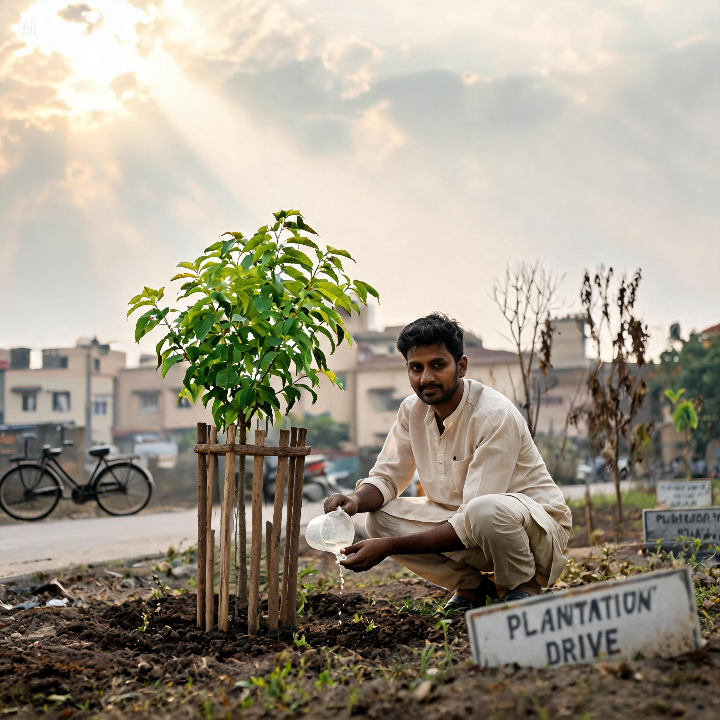
The story that stuck with me the most this year, though, was a much smaller one, and it had nothing to do with crore-scale targets. A residents' welfare association in Vasanthanagar, Bengaluru planted 350 saplings back in 2016, after first mapping out spots that avoided drains, manholes and parking spaces so no tree would ever need to be cut down later. Four years on, 99 percent of those trees, mostly native species like honge, neem and sampige, were alive and thriving, because the association kept watering them, fenced them off from cars, and treated planting day as the start of the job rather than the end of it. That, to me, is closer to what a nature warrior actually looks like. Not the person who shows up for one plantation photo in June, but the one still checking on the same tree eighteen months later.
I keep coming back to this because it is basically the same lesson behind everything else on this website. A sapling planted with no follow up and a sustainable product bought once out of guilt achieve about the same thing, which is not much. What moves the needle is unglamorous and repeated: watering a tree every week for two years, or switching to the eco-friendly option every single month instead of just once. India does not have a shortage of good intentions or plantation drives. If anything, it has too many one-day events and not enough people willing to check back eighteen months later. That follow through is the part worth paying attention to next monsoon, more than the crore counts announced at the microphone.
## Sources and further reading
- [Delhi's 2026 Mega Plantation Drive progress, PTI via The Print](https://theprint.in/india/around-40-49-lakh-saplings-planted-under-delhi-govts-2026-plantation-drive-58-pc-target-achieved/3013096/)
- [Uttar Pradesh's 2026 plantation numbers, PTI via The Print](https://theprint.in/india/up-plantation-drive-has-become-mass-movement-35-cr-more-saplings-to-be-planted-jul-12-cm/2979245/)
- [West Bengal's 2026 sapling target, PTI via The Print](https://theprint.in/india/over-7-crore-saplings-to-be-planted-in-west-bengal-in-2026-suvendu/2985626/)
- [Gondia district's 2026 plantation plan, Navbharat Live](https://navbharatlive.com/maharashtra/gondia/gondia-tree-plantation-drive-1-72-crore-plants-2026-1827588.html)
- [Gujarat, Madhya Pradesh and national plantation events, All India Radio News](https://newsonair.gov.in/india-conducts-massive-tree-planting-campaign-across-country/)
- [Karnataka forest survival rate scrutiny, Deccan Herald](https://www.deccanherald.com/india/karnataka/forest-dept-planted-15-cr-saplings-in-last-5-years-1237033.html)
- [Maharashtra's 50 crore plantation drive probe, The Hitavada](https://thehitavada.com/Encyc/2024/7/15/No-irregularity-but-action-against-66-staffers-for-laxity-Probe-report.html)
- [Uttar Pradesh survival rate and geo-tagging, Earth.Org](https://earth.org/?p=22732)
- [Bengaluru citizens' 99 percent tree survival story, The Better India](https://thebetterindia.com/221953/bengaluru-citizen-initiative-plant-tree-survival-rate-green-cover-india-gop94)